
怪物岛
4,220-year-old rock art in SW China’s Yunnan reveals early cultural links with Southeast Asia_我的网站

A |
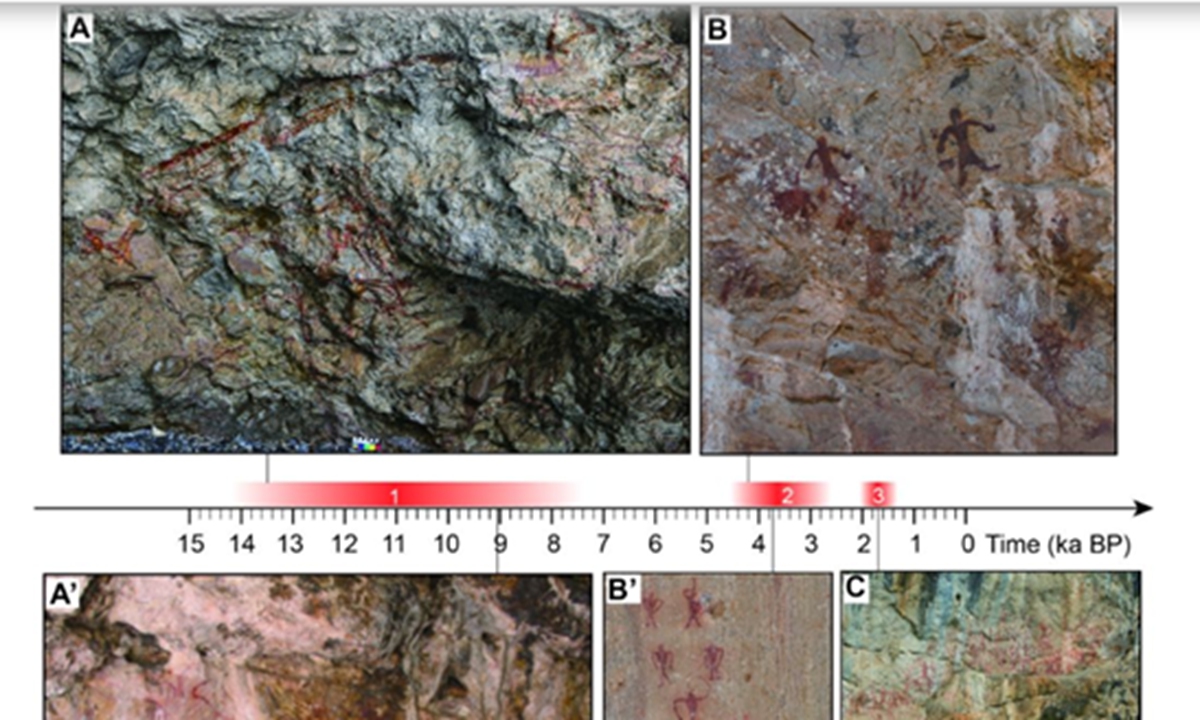
Chinese researchers have obtained the first absolute dates for rock paintings at the Mangguan rock art site in Southwest China's Yunnan Province, pushing the known history of rock art created by prehistoric settled communities in the region back to about 4,220 years ago. The paintings also suggest cultural interactions more than 4,000 years ago between Southwest China and civilizations along the Yellow and Yangtze rivers, as well as possible exchanges with neighboring parts of Southeast Asia, including present-day Myanmar, Thailand and Vietnam, a member of the research team told the Global Times.
The Yunnan Provincial Institute of Cultural Relics and Archaeology, in collaboration with Nanjing Normal University and other institutions, have recently made a significant archaeological breakthrough. Through systematic surveys and uranium-thorium (U-Th) dating at the Mangguan site in Gengma county, the research team obtained the first absolute dates for the site's rock paintings, tracing rock art created by prehistoric settled communities back to around 4,220 years ago.
The findings were recently published in the international journal Journal of Archaeological Science: Reports.
The Mangguan rock paintings represent one of the best-preserved prehistoric rock art sites in Yunnan. The research team presented high precision U Th dating of carbonate accretions that stratigraphically overlie the painted motifs at the Mangguan site, according to the paper published in the journal.
The dating results show that carbonate deposits overlying a human figure yielded a corrected age of 4,240 ± 19 years before present, confirming that ancient people living in the region had already produced mature figurative art at least 4,220 years ago, Wu Yun, first author of the paper and an associate researcher at the Yunnan Provincial Institute of Cultural Relics and Archaeology, was cited by the Xinhua News Agency report as saying.
Dating results from 11 samples taken from different motifs clustered between about 3,907 and 3,056 years ago. By comparison, the Cangyuan cliff paintings had previously been dated to roughly 3,800 to 2,700 years ago. The Mangguan paintings are therefore significantly older, filling an important chronological gap in the region's artistic record before the Cangyuan phase.
Shao Qingfeng, corresponding author of the paper and a professor at the School of Geography at Nanjing Normal University, told the Global Times that previous estimates dated the Mangguan rock paintings to a little over 3,000 years ago based mainly on imagery and comparisons with similar regional sites. Using microsamples of secondary carbonate deposits overlying the paintings, researchers have now obtained a precise minimum age of about 4,220 years before present without damaging the rock art.
The findings and the establishment of this chronological framework not only strengthen the archaeological foundation for studying rock art in Southwest China, but also provide a direct reference for rock art sites across Southeast Asia that have yet to undergo systematic dating, Shao said.
The findings may also challenge long-held perceptions of Southwest China around 4,200 years ago - roughly the era of the Xia Dynasty (c.2070 BC-C.1600 BC) - and help fill a key gap in understanding the pluralistic yet integrated development of Chinese civilization.
Shao said that while academic research has traditionally focused on the Yellow River and Yangtze River basins as cradles of early Chinese civilization, sites such as Mangguan and Cangyuan show that stable and culturally active communities also thrived in mountainous Southwest China. The newly established rock-art chronology brings an artistic dimension to the broader narrative of China's enduring cultural development.
Moreover, stylistic similarities suggest that Southwest China maintained exchanges with the Yellow River and Yangtze River regions and with early societies in Southeast Asia, providing material evidence of cross-regional interaction more than 4,000 years ago.
。
[ 新车上市] 6月30日,比亚迪旗下小型电动车——海鸥自在版正式上市,共推出1款配置,售价为7.88万元。值得一提的是,在比亚迪西安工厂内,随着一辆比亚迪海鸥缓缓驶出总装线,海鸥100万目标正式达成。
。
B | 从上市到累销百万,海鸥仅用27个月时间。该车依托e平台3.0技术,搭载智能座舱高阶版-DiLink 100等,为其带来不错的产品竞争力。关于新车详细售价,请见下图:

C |
侧面来看,新车采用了悬浮式车顶设计,同时向上俯冲的腰线与门板线条巧妙融合,营造出了海鸥的飞行姿态。车尾部分,贯穿式尾灯具有很强的辨识度,两侧尾灯造型比较犀利。后保险杠的造型与车头形成呼应,另外还有大尺寸扰流板和扩散器提升运动感。车身尺寸方面,新车长宽高分别为3780/1715/1540mm,轴距为2500mm。
D |

E |
Current article:http://mt4.pisezuibanzoukou.cyou/3u6lf/l0vtej.html
Published on:16:15:51
我的网站相关内容
 200 亿美元收购成果落地:英伟达 Groq 3 LPX 机架全面量产,今年上线
 古尔曼:苹果智能家居显示屏仍有望于今年推出
 SC: ED challenges bail granted to ex-Maha HM Deshmukh
 《红色沙漠》公开“目前为止的更新内容”
 国补结束了吗?国补政策2025什么时候结束已确定:国补截止时间为12月31日结束
 巴恩斯主动削减出手强化防守 具备争冠基石潜质
- ·VEVA OPEN春季大满贯:邓沛恩参赛,与成都业余网球高手同场角逐
- ·华为余承东:智界 V9 汽车 7 月高端 MPV 市场零售占有率达到 68%
- ·Shanxi completes first invasive brain-computer interface implant surgery
- ·Exclusive: 'Super map’ rewrites moon’s geo-clock, ‘an important foundation for humanity to explore deep space,’ project scientists tell GT
- ·一根碳纤维,拉起中国超级大桥|活力中国调研行
- ·【汽车行业周报】尊界或降价当门面,尚界或负责走量扛大梁
- ·校园采风 | 潜入深蓝, 探索生命的奥秘:星河湾学子的MBL探索之旅
- ·一株、两株、三株…… 用作云南白药重要成分的七叶一枝花被盗挖18株 临安两男子被判有期徒刑并处罚金
我的网站最新内容
- ·4.9-magnitude earthquake strikes Sichuan's Yibin
- ·中国地震局迅即开展青海海西州直辖区5.6级地震应急处置工作
- ·六大AI模型被扔进加密市场厮杀,DeepSeek暂为交易之王
- ·曝DDR5内存91%是脚本机器人在"抢"!普通人想买会更难
- ·Off-duty pilot charged with 83 counts of attempted murder for allegedly trying to shut off engines on Alaska Airlines flight
- ·提升公路属性 福特F-150 Lobo套件版官图发布 战斗氛围拉满
- ·USB 80Gbps接口标准正式发布 USB 3.0/USB4称呼被淘汰
- ·【仓单】8月26日郑商所PTA期货仓单较上一日下降423张
- ·杭州首个千吨级内河港海关监管场所通关启用 下沙港成为外贸企业“家门口一站式出海口”
- ·2023年全国居民健康素养水平达到29.70%
- ·2025:新加坡将提高养老预算 帮助降低生活成本
- ·世体:巴萨将比西武纳入一线队计划,目前他正随B队训练
- ·美国股市持续下滑 道琼斯指数下挫1100点
- ·“의사 남편 만나려 가입했는데”…듀오 ‘전문직 최다’ 허위 광고 딱 걸렸다
- ·“八二三炮战”68周年,赖清德叫嚣“寸土不让”遭打脸,卢秀燕:岂可让“台独”拿下台中?
- ·大ブレイクから18年 鼠先輩が現在の収入を赤裸々告白 都内に8000万円相当の一軒家を所有
我的网站热点内容
- ·【观点】广州期货:沥青国际原油价格大跌,成本端支撑减弱
- ·U18男篮亚洲杯-中国男篮大胜卡塔尔 郝煊18分
- ·《全球使命3》全新版本武器灭却之剑今日首登
- ·痛心!19岁失联女大学生姜宏宇遗体被找到,警方通报,死因曝光
- ·2 people dead, 11 injured in Serbian bridge collapse
- ·签署海洋安全合作备忘录、举行联合军演…日印为何强化防务合作
- ·新加坡本科留学:高一高二申请,还是高三毕业后?
- ·刘国中出席第十一届亚太经合组织粮食安全部长级会议开幕式并致辞
- ·小庄子镇:“蒜”出致富前景 种出幸福日子
- ·中信期货:PX成本松动,供需同升阶段跟随油价波动
- ·政府开始削减经费,这个部门率先裁撤40个职位
- ·美国亚马逊Intel无核核心i5-9400F约1400元
- ·坎宁安表态只关心活塞赛场实力 不介入引援琐事
- ·【品种策略】原油:08月26日多家期货公司晨报观点汇总
- ·宇树科技连跌5日 股价跌破600元 市值较历史高点蒸发2000亿元
- ·54人兼职群 53个是骗子!警方揭秘刷单连环套骗局